
Payroll & Cashier Support Services
Payroll & Treasury
One-stop payroll and treasury outsourcing—so you can focus on your business with stronger finance and HR operations.
Payroll Outsourcing
Payroll Outsourcing
Salary, Bonus, OT & Attendance
Insurance & Pension Setup/Changes
Withholding & NHI (2nd Gen) Filing
CN/EN Payroll Sheets & Encrypted Payslips
Annual Withholding, Departure Tax & Severance
Leave & Attendance Management
Journal Entries Support
Labor/Payroll Advisory & Training
Payout & Payment Handling
Treasury Outsourcing
Cashier Support Outsourcing
Payment Review & Payable List
Online Banking & Payments
Expenses & Petty Cash
Counter Tasks, FX, Checks & Deposits
Automation for Visibility & Efficiency
Why Choose Us
- Lower Cost: no payroll system or full-time headcount needed.
- Expert Team: CPA, bookkeepers, and HR specialists.
- No Disruption: reduce turnover and handover risk.
- Confidential & Compliant: lower tax and labor dispute risk.
- Visibility: track payments and cash flow in real time.
- One-Stop: one point of contact, fewer gaps.
Payroll & Treasury Outsourcing FAQ
This is not just terminology—it directly affects compliance cost (insurance, overtime, audits). We recommend judging by substance, not the label.
- Almost always treated as wages (include)
If it is work-related (consideration) and regularly paid, it is wage—no matter what you call it.
- Base Salary
- Fixed Allowances: Position allowance, language allowance, expatriate allowance, meal allowance (even if tax-exempt), fixed transportation allowance
- Attendance Bonus : if systematic and routinely paid, it is usually treated as wage
- Gray areas (depends on design)
- Performance/Sales Bonus
- If paid monthly, fixed, and broadly granted, it may be treated as disguised wage (included for insurance and overtime calculations).
- If performance-based, variable, non-regular (no performance = no bonus), it may be excluded from “average wage” for labor purposes.
- Year-end/Festival Bonus : If not contractually guaranteed as Guaranteed Annual Pay, it is usually treated as discretionary (not included in average wage), but still taxable and may trigger NHI supplemental premium.
- Usually excluded (reimbursement-based)
- Travel/Entertainment Expenses : Must be supported by receipts, reimbursement basis, and within tax limits
- Employer-paid 6% Pension Contribution : Employer cost, not employee salary income
This is a key tax issue for multinationals. The core is cash flow and contract structure. High-risk (treated as taxable salary)與「合約」。
- High-risk (treated as taxable salary)
Company wires cash (e.g., NT$50,000) to the employee for rent. The tax authority may treat it as a cash allowance and tax it as salary. - Recommended (treated as company expense; non-taxable to employee)
- Contract party : The company signs with the landlord/school
- Payment : Company pays the landlord/school directly (or employee advances then reimburses with receipts)
- Policy : A clear internal policy stating this is a business-required expatriate expense
Conclusion : With the above, you can support the position that this is a business expense, not taxable salary to the employee.
Minimum wage is updated annually. Please follow the latest Ministry of Labor announcement.
2025 (ROC Year 114) :
- Monthly : NT$ 28,590
- Hourly : NT$ 190
Yes—first confirm the work permit type to avoid illegal employment.
Status | Work Permit Needed? | Notes |
Employment Gold Card holder | No | Gold Card includes open work authorization (4-in-1). |
Foreign spouse | No | Must be married to a household-registered national and have residence rights. |
APRC (Permanent Residency) | No | After 2024 amendments, many APRC holders have open work rights. |
Foreign professionals | Yes | Employer must apply to MOL; salary/education/experience thresholds apply. |
Foreign students | Yes | Current students must obtain a student work permit (max 20 hrs/week). Graduates require employer application (points-based). |
HR SOP: Before onboarding, request the original ARC or Gold Card, and keep a photo copy on file.
This is frequently miscalculated. The key is tax residency (183-day rule).。
Step 1: Count days
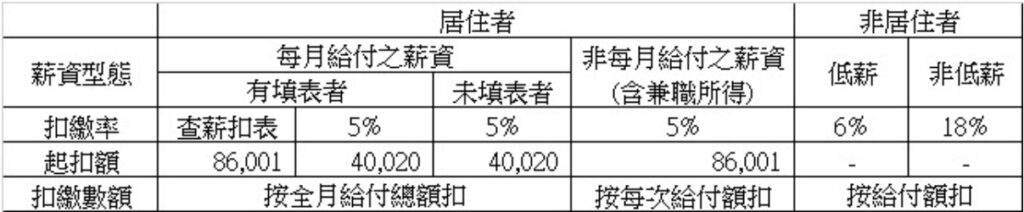
- Resident (183+ days) : Taxed similar to local residents.
- Non-resident (<183 days) : Withholding applies at higher rates and no personal deductions.
Step 2: Apply withholding rate
- Resident : Follow the salary withholding table, or withhold a flat 5% (many foreign firms choose 5%). 5%(外商通常選 5%)。
- Non-resident : Standard rate 18%。
- Non-resident (low-salary exception) : If monthly salary ≤ 1.5× minimum wage (about NT$42,885 in 2025), rate may be 6%. 6% 優惠稅率。
Practical note : If an employee joins in January and is expected to stay all year, you may withhold as resident (5%). If they leave early and fail the 183-day test, the company must top up the difference to the non-resident rate and file a correction.
It is an additional premium (current rate 2.11%) imposed on income beyond regular payroll.
- Paid by employees (bonus-type)
- Trigger : When cumulative bonuses (year-end bonus, profit sharing, etc.) exceed 4× the monthly insured salary.
- Threshold : The portion of "cumulative" annual bonuses that exceeds 4 times the employee's "monthly insured salary."
- Formula : (Cumulative bonus − 4 × insured salary) × 2.11%
- Collected by : Employer withholds at payout.
- Paid by employers (salary-gap type)
- Logic : if total salary paid is higher than total insured salary, the gap is assessed.
- Formula : (Total monthly salary paid − Total monthly insured salary) × 2.11%
- If you have 5+ employees (including 5):
Must set up an enrollment unit and enroll all employees in Labor Insurance + Employment Insurance + Occupational Accident Insurance. - If you have 4 or fewer employees :
- Labor Insurance : optional by law. Employees may join via an occupational union instead. We strongly recommend enrolling, because in a workplace accident, Labor Insurance can significantly reduce employer liability.
- Employment Insurance & Pension (6%) : still mandatory even if Labor Insurance is not joined.
- If you have no employees (only the owner) :
You cannot set up a Labor Insurance unit. The owner should join via an occupational union or National Pension (as applicable). - Important—NHI rule :
Regardless of headcount (even 1 person), once you form a company, you must set up an NHI enrollment unit.
- Labor Insurance (not mandatory) :必須先幫員工加保,老闆才能跟著保在公司。投保薪資不得低於員工(通常保最高級距 45,800 元)。
- NHI (mandatory) : The owner must enroll as the Responsible Person under the company (not via union or as a dependent). • If the owner has another full-time job, NHI stays with the primary employer; the new company enrolls employees only.
If there is an employment relationship, generally yes.
- Labor Insurance : required. Long-term part-timers enroll monthly (insured salary not below NT$11,100) and marked as part-time; day workers enroll by day.
- NHI : Choose one enrollment (often stays under prior coverage such as as a dependent or via school).
- Pension (6%) : Employer must contribute regardless of full-time/part-time.
- Dependent strategy : Attach dependents to the lower-salary insured person.
- Large-family rule : Under the same insured person, dependents from the 4th onward may be exempt from premiums.
- Multiple-job strategy : Enroll under the higher-salary job to avoid unnecessary supplemental premiums (case-by-case).
Beyond salary, statutory costs include :
- Labor Insurance : Salary × ~8% (employer pays ~70%)
- NHI : Salary × ~3.1% (employer pays ~60%)
- Pension : Salary × 6% (employer pays 100%)
Conclusion : Total employer cost is typically ~1.15–1.20× the salary.
This is a classic “small saving, big loss” risk.
- Failure to enroll / under-reporting : Penalties up to 4× the unpaid premium.
Worst case : If a workplace accident occurs, the employer may be liable for the benefits that should have been paid by the system (often starting from hundreds of thousands).
They are separate benefits; you may receive both.
Item | Labor Pension (New System) | Labor Insurance Old-Age Benefit |
Who pays | Employer (into your personal account) | Government insurance benefit |
Funding | Employer contributes 6% monthly | Calculated from paid premiums |
When you can claim | From age 60, regardless of retirement status | Age and contribution-year requirements apply |
Bankruptcy risk | No (personal account) | System pressure exists, but government-backed |
Quick memory | Employer retirement savings | Social insurance pension |
Summary: Pension is your personal account; Labor Insurance is social insurance. They run in parallel.
Yes. If the responsible person has actual labor participation and is properly enrolled, they can claim old-age benefits under the same rules (e.g., age 60–65 and contribution requirements).
No. It is age-based, not employment-status-based. From age 60, you can claim it regardless of whether you are still working or enrolled.
It usually depends on whether you have 15+ years of insured seniority :
- 15+ years : Typically monthly pension (the longer you live, the more you receive).
- <15 years : Lump-sum benefit only.
Exception : Some legacy insured periods (before Jan 1, 2009) may allow a special lump-sum option if conditions are met.
Retirement Pay = Average Wage × Base Units
- First 15 years : 2 units per year
- From year 16 onward : 1 unit per year
Cap : Maximum 45 units
This is a common misconception and a key focus of labor inspections. What matters is the actual working relationship, not the contract title. If these “subordination” factors exist, it is treated as employment :
- Personal subordination : Company directs and supervises, attendance rules apply
- Economic subordination : Works mainly/only for your company, limited freedom to take other clients
- Organizational subordination : Integrated into your org structure
Expert advice : If using contractors (no labor/NHI enrollment), ensure high autonomy (time/place/method). Otherwise it may be deemed “fake contractor, real employee,” with severe penalties.
It depends on the nature of work :
- Salary income (Code 50) : If it is employment in substance
- Professional practice income (Code 9A/9B) : e.g., lawyers/CPAs or skilled professionals operating independently, with their own tools and business risk
Key difference : Professional income may claim deemed costs, but misclassification creates tax adjustment risk.
- Directors only (board duties only) : Typically meeting fees or profit distribution; treated as other income/dividends; no Labor Insurance/Pension enrollment.
- Directors with employee role (active management) : e.g., also GM with fixed salary—must enroll and treated as salary income.
- Overtime pay has statutory multipliers :
- Weekday OT first 2 hours :×1.34
- Weekday OT hours 3–4 :×1.67
- Rest-day overtime rates are higher
- Comp time requires consent : Comp time may replace OT pay if the employee agrees, generally 1:1. If unused by deadline, it must be paid out.
- Ceiling : Overtime limit is generally 46 hours/month.
- Employee (tax-exempt) : Legal overtime pay within 46 hours/month may be tax-exempt.
- Company risk : Tax authority may compare time records vs cash flow. If no overtime occurred but expenses are claimed, tax adjustment and penalties may apply.
- Complete time records : Keep for 5 years
- Clear payment evidence : Payslips should identify overtime items
Taiwan labor law (annual leave, marriage/funeral/sick/maternity leave) is the minimum standard.
Global policies must be localized. If HQ policy is stricter than Taiwan law (e.g., fewer leave days), you must adjust to comply.
- Regular day off (mandatory) : Typically Sunday; overtime is generally prohibited except emergencies.
- Rest day (adjustable) : Typically Saturday; overtime is permitted but costly.
- Annual leave : 3 days after 6 months; 7 days after 1 year; increases with seniority
- Marriage leave : 8 paid days
- Funeral leave (paid) : Parents/spouse 8; grandparents/children 6; siblings 3
We do more than payroll. We build a system that stands up to audits :
- Review employee handbook and work rules for legal updates
- Standardize overtime/leave workflows
- Automated checks during payroll to reduce disputes and compliance risk
In short, we take the time-consuming, unavoidable cash-handling tasks off you or admin staff. We help with :
- Invoice organization : verify vendor invoices and create a “who to pay / how much” list
- Online banking entry : key in transfer details (account/amount/memo) so you only need to log in and approve
- Bank runs : tax payments, check deposits, FX documents—queue time on us
- Petty cash control : review claims and prepare reimbursement packs for funding
- Clear records : reports that track cash movement for transparency
- Ceiling : Overtime limit is generally 46 hours/month.
- Treasury (we operate) : Cashflow execution (online banking entry, bank runs)
- Bookkeeping & tax (we record) : Accounting/tax (invoices, journals, filings)
- Benefit when combined : left hand pays, right hand books—highest efficiency and clean records.
Yes. We cannot move funds independently. We enforce segregation of duties:
- We prepare : Organize and enter transactions
- You release : Only you hold final passwords/keys—no approval, no transfer
- Access control : Approval tiers per your policy (e.g., manager for small amounts, chairman for large)
- Audit trail : Digital records for audit needs
- Security : Encrypted transmission and strict access permissions
- Foreign firms or startups : HQ internal control requirements without a full finance team
- Owner-operated businesses : Outsource to free up leadership time
- High turnover : Avoid painful handovers and cashflow chaos
- Control-focused teams : Need transparent, traceable payment workflows
No. The pay/no-pay decision always stays with you.
We prepare and remind deadlines, but when and whether to approve is entirely your decision.