
Payroll & Cashier Support Services
Payroll & Cashier Support
One-stop payroll and treasury outsourcing—so you can focus on your business with stronger finance and HR operations.
Payroll Outsourcing
Payroll Outsourcing
Salary, Bonus, OT & Attendance
Insurance & Pension Setup/Changes
Withholding & NHI (2nd Gen) Filing
CN/EN Payroll Sheets & Encrypted Payslips
Annual Withholding, Departure Tax & Severance
Leave & Attendance Management
Journal Entries Support
Labor/Payroll Advisory & Training
Payout & Payment Handling
Treasury Outsourcing
Cashier Support Outsourcing
Payment Review & Payable List
Online Banking & Payments
Expenses & Petty Cash
Counter Tasks, FX, Checks & Deposits
Automation for Visibility & Efficiency
Why Choose Us
- Lower Cost: no payroll system or full-time headcount needed.
- Expert Team: CPA, bookkeepers, and HR specialists.
- No Disruption: reduce turnover and handover risk.
- Confidential & Compliant: lower tax and labor dispute risk.
- Visibility: track payments and cash flow in real time.
- One-Stop: one point of contact, fewer gaps.
Payroll & Treasury Outsourcing FAQ
I. Compensation & Taxation
Q1: For foreign companies, which pay items are treated as “wages” in Taiwan?
This is not just terminology—it directly affects compliance cost (insurance, overtime, audits). We recommend judging by substance, not the label.
- Almost always treated as wages (include)
If it is work-related (consideration) and regularly paid, it is wage—no matter what you call it.
- Base Salary
- Fixed Allowances: Position allowance, language allowance, expatriate allowance, meal allowance (even if tax-exempt), fixed transportation allowance
- Attendance Bonus: If paid regularly as part of a structured policy, it is generally treated as "Wages."
- Gray areas (depends on design)
- Performance/Sales Bonus
- If paid monthly, fixed, and broadly granted, it may be treated as disguised wage (included for insurance and overtime calculations).
- If performance-based, variable, non-regular (no performance = no bonus), it may be excluded from “average wage” for labor purposes.
- Year-end/Festival Bonus : If not contractually guaranteed as Guaranteed Annual Pay, it is usually treated as discretionary (not included in average wage), but still taxable and may trigger NHI supplemental premium.
- Usually excluded (reimbursement-based)
- Travel/Entertainment Expenses : Must be supported by receipts, reimbursement basis, and within tax limits
- Employer-paid 6% Pension Contribution : Employer cost, not employee salary income
Q2: Are expatriate benefits (housing, tuition, relocation) taxable as salary?
This is the most critical tax-saving strategy for foreign firms. The key factors are "Cash Flow" and "Contractual Structure."
- High-risk (treated as taxable salary)
Company wires cash (e.g., NT$50,000) to the employee for rent. The tax authority may treat it as a cash allowance and tax it as salary. - Recommended (treated as company expense; non-taxable to employee)
- Contract party : The company signs with the landlord/school
- Payment : Company pays the landlord/school directly (or employee advances then reimburses with receipts)
- Policy : A clear internal policy stating this is a business-required expatriate expense
Conclusion : With the above, you can support the position that this is a business expense, not taxable salary to the employee.
Q3: What is Taiwan’s current minimum wage?
Minimum wage is updated annually. Please follow the latest Ministry of Labor announcement.
2025 (ROC Year 114) :
- Monthly : NT$ 28,590
- Hourly : NT$ 190
Q4: Can we hire foreigners in Taiwan?
Yes—first confirm the work permit type to avoid illegal employment.
Status | Work Permit Needed? | Notes |
Employment Gold Card holder | No | Gold Card includes open work authorization (4-in-1). |
Foreign spouse | No | Must be married to a household-registered national and have residence rights. |
APRC (Permanent Residency) | No | After 2024 amendments, many APRC holders have open work rights. |
Foreign professionals | Yes | Employer must apply to MOL; salary/education/experience thresholds apply. |
Foreign students | Yes | Current students must obtain a student work permit (max 20 hrs/week). Graduates require employer application (points-based). |
HR SOP: Before onboarding, request the original ARC or Gold Card, and keep a photo copy on file.
Q5: How do we withhold income tax for foreign employees? (Withholding Tax)
This is where errors most often occur. The core criteria is the 'Resident' definition (staying 183 days).
Step 1: Count days
- Resident (183+ days) : Taxed similar to local residents.
- Non-resident (<183 days) : Withholding applies at higher rates and no personal deductions.
Step 2: Apply withholding rate
- Resident: You can use the official "Salary Withholding Table" (based on the number of dependents) or simply withhold a flat 5%. Most foreign firms prefer the 5% flat rate for administrative simplicity.
- Non-resident: The standard withholding rate is 18%.
- Non-resident (Preferential Rate): If the employee's total monthly salary is equal to or less than 1.5 times the statutory minimum wage (approx. NT$42,885), the rate is reduced to 6%.
Practical note : If an employee joins in January and is expected to stay all year, you may withhold as resident (5%). If they leave early and fail the 183-day test, the company must top up the difference to the non-resident rate and file a correction.
Q6: What are the withholding rates, thresholds, and tax amounts for different income types?
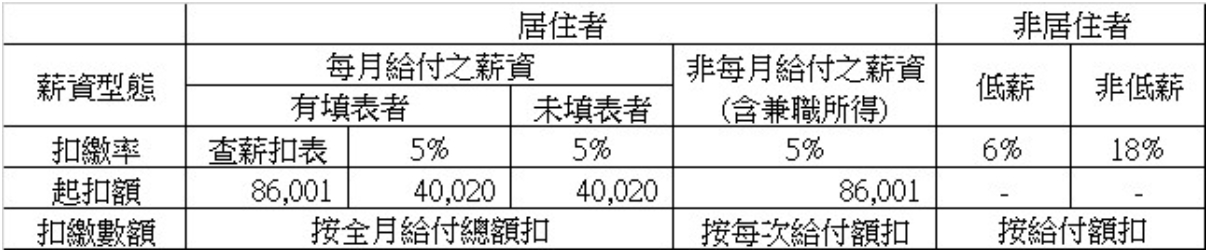
Q7: What is the NHI “supplemental premium” (2nd Gen NHI)? How is it calculated?
It is an additional premium (current rate 2.11%) imposed on income beyond regular payroll.
- Paid by employees (bonus-type)
- Trigger : When cumulative bonuses (year-end bonus, profit sharing, etc.) exceed 4× the monthly insured salary.
- Threshold : The portion of "cumulative" annual bonuses that exceeds 4 times the employee's "monthly insured salary."
- Formula : (Cumulative Bonuses – 4 × Monthly Insured Salary) × 2.11%.
- Collected by : Employer withholds at payout.
- Paid by employers (salary-gap type)
- Trigger : When the total payroll paid by the company in a month exceeds the total sum of all employees' monthly insured salaries, the government considers the difference as "uninsured salary" and requires a supplemental contribution.
- Formula : (Total Monthly Payroll Paid – Sum of All Employees' Monthly Insured Salaries) × 2.11%.
II. Labor Insurance & Pension
Q1: Must a new company set up Labor/NHI insurance enrollment units immediately?
- If you have 5+ employees (including 5):
Must set up an enrollment unit and enroll all employees in Labor Insurance + Employment Insurance + Occupational Accident Insurance. - f you have 4 or fewer employees (Hybrid Requirement)
- Labor Insurance : This is technically voluntary. The law allows small firms not to form a unit (employees may join via unions). However, we advise against this. If an employee suffers an injury, Labor Insurance payouts cover the employer’s legal compensation obligations. Without it, the employer must pay the full amount out of pocket.
- Mandatory Items: Even with only 1 employee, you must enroll them in Employment Insurance and contribute the 6% Labor Pension.
- If you have no employees (only the owner) :
You cannot set up a Labor Insurance unit. The owner should join via an occupational union or National Pension (as applicable). - Important—NHI rule :
Regardless of headcount (even 1 person), once you form a company, you must set up an NHI enrollment unit.
Q2: How should the owner enroll in Labor/NHI insurance?
- Labor Insurance (not mandatory) :The owner can only enroll in the company’s Labor Insurance unit if there is at least one other employee enrolled in that same unit. Furthermore, the owner’s insured salary grade cannot be lower than that of the highest-paid employee (usually, owners enroll at the maximum tier of NT$45,800).
- NHI (mandatory) : The owner must enroll as the Responsible Person under the company (not via union or as a dependent). • If the owner has another full-time job, NHI stays with the primary employer; the new company enrolls employees only.
Q3: Do part-timers and interns need Labor/NHI insurance?
If there is an employment relationship, generally yes.
- Labor Insurance : Enrollment is mandatory. Regular part-timers should be insured on a monthly basis. The insured salary cannot be lower than the statutory minimum for part-time workers (NT$11,100). You must check the "Part-time" (部分工時) box in the system. For temporary workers (e.g., event staff), you should enroll them on their start date and withdraw them on their end date.
- NHI : Choose one enrollment (often stays under prior coverage such as as a dependent or via school).
- Labor Pension: Regardless of whether the staff is full-time or part-time, the employer must contribute 6% to their individual labor pension account.
Q4: Any legal ways to reduce NHI premiums?
- Dependent strategy : Attach dependents to the lower-salary insured person.
- Large-family rule : Under the same primary insured person, premiums are waived starting from the 4th dependent. If you have a large family, it is most cost-effective to concentrate all dependents under one person.
- Multiple-job strategy : Enroll under the higher-salary job to avoid unnecessary supplemental premiums (case-by-case).
Q5: What is the employer’s real cost for one employee? (2025 estimate)
Beyond salary, statutory costs include :
- Labor Insurance : Salary × ~8% (employer pays ~70%)
- NHI : Salary × ~3.1% (employer pays ~60%)
- Pension : Salary × 6% (employer pays 100%)
Conclusion: The employer's real cost is approximately 1.15 to 1.2 times the employee's gross salary.
Q6: What happens if we fail to enroll employees, or under-report salary?
This is a classic “small saving, big loss” risk.
- Fines: For failure to enroll or under-reporting salary, the Bureau can impose a fine of 4 times the amount of the premiums that should have been paid.
Worst-Case Scenario: If an occupational accident occurs and the employee is not properly insured, the employer is not only fined but is also legally required to pay the full amount of benefits that the Labor Insurance Bureau would have otherwise covered (this often starts at hundreds of thousands of NTD).
Q7: What’s the difference between Labor Pension (6%) and Labor Insurance old-age benefits?
They are separate benefits; you may receive both.
Item | Labor Pension (New System) | Labor Insurance Old-Age Benefit |
Who pays | Employer (into your personal account) | Government insurance benefit |
Funding | Employer contributes 6% monthly | Calculated from paid premiums |
When you can claim | From age 60, regardless of retirement status | Age and contribution-year requirements apply |
Bankruptcy risk | No (personal account) | System pressure exists, but government-backed |
Quick memory | Employer retirement savings | Social insurance pension |
Summary: Pension is your personal account; Labor Insurance is social insurance. They run in parallel.
Q8: As a responsible person, if I also enroll in Labor Insurance, can I claim old-age benefits?
Yes. As long as the Responsible Person is "actually engaged in labor" and participates in Labor Insurance according to the regulations, they are eligible to claim the "Labor Insurance Old-Age Benefits" from the Bureau of Labor Insurance once they meet the age and seniority requirements (typically between ages 60 and 65).
Q9: For Labor Pension (6%), must I stop working to withdraw it?
No, it is based on age, not employment status.According to the regulations, once you reach 60 years of age, you are eligible to apply for the withdrawal of funds from your individual labor pension account. This applies regardless of whether you are still working or currently enrolled in the insurance system. (You may choose between a lump-sum payment or a monthly annuity, depending on the total balance and years of contribution in your account.)
Q10: Labor Insurance old-age benefit—lump sum or monthly pension? Any limits?
It usually depends on whether you have 15+ years of insured seniority :
- 15+ years : Typically monthly pension (the longer you live, the more you receive).
- <15 years : Lump-sum benefit only.
Exception : Some legacy insured periods (before Jan 1, 2009) may allow a special lump-sum option if conditions are met.
Q11: For legacy employees under the old pension system, how is retirement pay calculated? What is the cap?
The Bureau of Labor Insurance will automatically "select the most favorable amount" for you. Usually, Method 2 results in a higher payout:
- Method 1: Designed to protect low-income earners.$$(Average Monthly Insured Salary x Seniority x 0.775%) + NT$3,000
- Method 2: The choice for the majority of people. (Average Monthly Insured\ Salary x Seniority x 1.55
Note: If you choose the monthly pension, the "45-month cap" does not apply; you will receive payments for as long as you live.
III. Outsourcing & Contractors
Q1: Can we avoid full-time headcount by signing a “contractor agreement”?
This is a common misconception and a key focus of labor inspections. What matters is the actual working relationship, not the contract title. If these “subordination” factors exist, it is treated as employment :
- Personal subordination : Company directs and supervises, attendance rules apply
- Economic subordination : Works mainly/only for your company, limited freedom to take other clients
- Organizational subordination : Integrated into your org structure
Expert advice : If you wish to use a "Contractor" (Independent Service) model to avoid Labor/NHI costs, you must ensure the worker has high autonomy. They should decide their own time, location, and methods. Otherwise, this is considered "Disguised Labor," and the penalties for misclassification in 2026 are extremely high.
Q2: For “consultants” or freelancers, how do we report payments?
It depends on the nature of work :
- Salary income (Code 50) : If it is employment in substance
- Professional practice income (Code 9A/9B) : Applicable if the recipient is a licensed professional (e.g., Lawyer, CPA) or an independent specialist (e.g., Designer) who provides their own tools, operates independently, and bears their own business risks (profit/loss).
Key difference : Professional income may claim deemed costs, but misclassification creates tax adjustment risk.
Q3: Are director/supervisor payments salary? Do they require enrollment?
- Pure Directors/Supervisors (Meetings only): They receive "Attendance Fees / Profit Distributions," categorized as Other Income or Dividends. No Labor Insurance or Pension enrollment required.
- Executive Directors/Supervisors (Active Management): If acting as General Manager with a fixed salary, they must enroll in Labor/Health Insurance and Pension. Income is categorized as "Salary Income."
IV. Leave & Overtime
Q1: How is overtime pay calculated? Can we use comp time?
- Overtime pay has statutory multipliers :
- Weekday OT first 2 hours :×1.34
- Weekday OT hours 3–4 :×1.67
- Rest-day overtime rates are higher
- Consensus for Comp Time (1:1): Comp time can replace OT pay, but requires employee consent. In principle, it's 1:1. If not used by the deadline, the company must pay back the cash.
- The Ceiling (Statutory Cap): Monthly overtime is capped at 46 hours.
Q2: Is overtime pay taxable? What if it is inflated?
- Employee (Tax-Free): Legally paid overtime within the 46-hour monthly cap is exempt from personal income tax.
- Company risk : Tax authority may compare time records vs cash flow. If no overtime occurred but expenses are claimed, tax adjustment and penalties may apply.
Q3: What do we need to book overtime as an expense?
- Complete time records : Keep for 5 years
- Clear payment evidence : Payslips should identify overtime items
Q4: What leave must we provide at minimum? Can we use a global policy as-is?
Taiwan labor law (annual leave, marriage/funeral/sick/maternity leave) is the minimum standard.
Global policies must be localized. If HQ policy is stricter than Taiwan law (e.g., fewer leave days), you must adjust to comply.
Q5: What’s the difference between “regular day off” and “rest day”?
- Regular Day Off (Mandatory Rest): Usually Sunday. Overtime is forbidden except for natural disasters or emergenci
- Rest Day (Flexible Adjustment): Usually Saturday. Overtime is allowed, but the overtime rates are very high.
Q6: Quick reference—how many days of leave?
- Annual leave : 3 days after 6 months; 7 days after 1 year; increases with seniority
- Marriage leave : 8 paid days
- Funeral leave (paid) : Parents/spouse 8; grandparents/children 6; siblings 3
Q7: Leave and overtime admin is painful—how can you help?
We do more than payroll. We build a system that stands up to audits :
- Review employee handbook and work rules for legal updates
- Standardize overtime/leave workflows
- Automated checks during payroll to reduce disputes and compliance risk
V. Treasury & Payments
Q1: What does your “treasury outsourcing” actually do?
In short, we take the time-consuming, unavoidable cash-handling tasks off you or admin staff. We help with :
- Invoice organization : verify vendor invoices and create a “who to pay / how much” list
- Online banking entry : key in transfer details (account/amount/memo) so you only need to log in and approve
- Bank runs : tax payments, check deposits, FX documents—queue time on us
- Petty cash control : review claims and prepare reimbursement packs for funding
- Clear records : reports that track cash movement for transparency
Q2: How is this different from bookkeeping/tax filing?
- Cashier (We execute for you): Focus is on cash flow operations (e.g., online banking, physical bank trips).
- Bookkeeping (We record for you): Focus is on accounting and tax (e.g., issuing invoices, vouchers, tax filing).
- Benefits of Integration: Streamlined payments and direct entry ensure peak communication efficiency and clean accounts.
Q3: If we let you handle payment ops, is our money safe?
Absolute Safety (No Solo Access): We cannot move funds alone. We strictly enforce "Separation of Duties".
- We prepare : Organize and enter transactions
- You release : Only you hold final passwords/keys—no approval, no transfer
Q4: How do you prevent data leakage or fraud?
- Access control : Approval tiers per your policy (e.g., manager for small amounts, chairman for large)
- Audit trail : Digital records for audit needs
- Security : Encrypted transmission and strict access permissions
Q5: Which companies are suitable for treasury outsourcing?
- Foreign firms or startups : HQ internal control requirements without a full finance team
- Owner-operated businesses : Outsource to free up leadership time
- High turnover : Avoid painful transitions and accounting chaos when a cashier leaves.
- Control-focused teams : Need transparent, traceable payment workflows
Q6: Will you decide whether we should pay?
No. The decision (Pay or Don’t Pay) remains with the client.
We prepare and remind deadlines, but when and whether to approve is entirely your decision.